Saturday, May 16, 2015

A Year...


Dear Dad,

It's been one year. 525,600 minutes, give or take, since we lost you. And while the loss is perhaps not as raw as it was those first few days, there's still an ache, a hurt, and most of all, a gigantic void in all of our hearts.

There's been so much you've missed over the last year, although I try to believe you've been watching over us, so you've seen it all. Hopefully you've seen the birthdays, the boys' shows and special achievements, the holidays. Maybe you've not had to see the struggles or the tears.

So many times I've picked up the phone to call you, to share both random and specific news. I had to stop myself from seeking your words of wisdom while Wayne's mom was fighting her own battles, had to stop myself from checking in with you every time I was on the road. And of course, you were the missing piece in the absolute excitement I felt when I finally got my first executive director job a few months ago. You know how long and how hard I've worked for this, and (at least in my opinion) so far, I'm pretty good at it.

But you also missed another crappy winter. I know you would have had some pointed words for what's been going on in our world. And more than that, I know you would have had some funny stories to tell.

I'm still at a loss a lot of the time. I've spent the entire year holding it together for everyone else, but there are the occasional cracks. But honestly, most of all, I feel the same way I did when I wrote what I said at your funeral.

Dad, I don't need milestone days like these to remember you, to cherish the memories, or appreciate the man you were. I do that every day. It's just, on days like these, it's just a little harder.

We love you, and I love you, with all of my heart, and I miss you more than words can say. So often I still am grateful for what you gave me and what you taught me, and simply for your being the man you were.

I love you,

Larry

Thursday, May 14, 2015

Book Review: "All Involved" by Ryan Gattis

I remember the beating of Rodney King, but what I remember more than that was the outrage and violence which exploded in Los Angeles in April of 1992, when three of the four white policemen accused of the beating were completely acquitted, while no verdict was reached on the fourth. It was utterly surreal to be living in Washington, DC, watching the rioting, looting, destruction, and violence that followed, a feeling I'd never thought I'd have again, yet I felt similarly a few weeks ago when similar incidents occurred in Baltimore.

Over a six-day period in 1992, 53 people were killed in the riots. But what few really understood was the violence that occurred outside the immediate epicenter of the riots, as Los Angeles-area gang members used the incidents as camouflage for their own activities, settling old scores with rival gangs jockeying for control, and taking whatever they could, by whatever means necessary. Ryan Gattis' magnificent, powerful All Involved is a fictionalized account of gang members and others caught up in the violence on the fringes of the riots, and how righting alleged wrongs and working to save face proved dangerous and often deadly.

Ernesto Vera works on a taco truck, but he has dreams of becoming a chef, and wants to get an apprenticeship at an exclusive Japanese restaurant so he can learn from the masters. Sent home early by a boss worried about the rioting, he is nearly home when he encounters a group of gang members looking to settle a score with his younger brother. This clash sets up a series of confrontations that affect a number of lives, including nurses, firemen, and students utterly unprepared for what is coming down the pike, both good and bad.

"There's a truth in that somewhere and maybe it's this—there's a hidden America inside the one we portray to the world, and only a small group of people ever actually see it. Some of us are locked into it by birth or geography, but the rest of us just work here. Doctors, nurses, firemen, cops—we know it. We see it. We negotiate with death where we work because that's just part of the job. We see its layers, its unfairness, its unavoidability. Still, we fight that losing battle. We try to maneuver around it, even occasionally even steal from it. And when you come across somebody else who seems to know it like you do, well, you can't help but stop and wonder what it'd be like to be with someone who can empathize."

Gattis tells 17 interconnected stories, imbuing his characters with life, emotion, and complexity, and he manages to make many of them characters you root for despite what they're doing. It's a talented author who makes you care about those who kill, injure, steal, and destroy, yet he doesn't paint over their flaws either. As you might imagine, some of the chapters are more interesting than others—I honestly would have been happy if the book had remained focused on the rival gangs and those caught up in their activities; I felt the book lost a bit of steam when it turned to other characters with only a slight connection.

Gattis' storytelling is gritty, violent, poetic, and powerful, and I was utterly hooked for the majority of the book. We hear all too often about the human toll that violence takes, but All Involved brings that home without being overly preachy. It's an unflinching look at a not-too-far-distant time in our society that sadly, we're not completely past yet. If you're a crime novel fan, this is definitely one to read and savor.

Monday, May 11, 2015

Book Review: "Bream Gives Me Hiccups" by Jesse Eisenberg

Full disclosure: I received an advance copy of this book from NetGalley in exchange for an unbiased review.

I tend to be dubious when I come across a book written by an actor. It's not that every actor is a bad writer; in fact, I've read some well-written books authored by actors, such as Ethan Hawke, Meg Tilly, and Lauren Graham. But of course, for every actor deserving of a book deal, there are many whose books are published only on the strength of their name and not any display of writing skill. (Cough, James Franco, cough.)

When I saw a friend had raved about Jesse Eisenberg's collection of stories, Bream Gives Me Hiccups, I was definitely intrigued. I'm a big fan of his acting and hoped that his wry, sarcastic sense of humor I've seen displayed in interviews would shine through. I also hoped that a book being touted as hysterically funny actually lived up to that billing.

I'm pleased to say Eisenberg succeeded on both fronts. This book is composed of a number of stories and humorous anecdotes which take different forms—text messages, email conversations, letters, conversations—and many made me laugh out loud. From the hilarious and touching title story, in which a nine-year-old boy reviews meals he has in different locations, many with his troubled mother, to an email conversation between a dating couple which gets hijacked by his sister, who is a scholar of the Bosnian genocide, some of these stories are laugh-out-loud funny and many others make you chuckle and shake your head at Eisenberg's ingenuity. And more than a few times, I could hear his voice coming through the narration, which added an extra layer of depth and humor.

In addition to the two stories I mentioned above, some of my favorites in this collection included (and many of the titles say all that needs to be said about the stories themselves): "My Prescription Information Pamphlets as Written by My Father"; "Carmelo Anthony and I Debrief Our Friends after a Pickup Game at the YMCA"; "If She Ran Into Me Now," in which a man is waiting for a glimpse of an ex-girlfriend; and "A Bully Does His Research," which I found perhaps a little too short.

Not every story works; there are times when Eisenberg goes for one more laugh where he could have held back, and times when the stories are more one-liner than plot, but even those are enjoyable in their own way. This was a quick, fun read, and I look forward to not only seeing more of his movies (he's playing Lex Luthor, y'all), but reading more of his books in the future. Perhaps he can pave the way for more actors with writing talent being published instead of those without it.

Sunday, May 10, 2015

Book Review: "Bright Shards of Someplace Else" by Monica McFawn

One thing I love so much about reading short stories is stumbling upon story concepts and characters I haven't seen before, and of course, finding beautiful writing. Both were on display in Monica McFawn's collection Bright Shards of Someplace Else.

The characters that populate McFawn's stories are all different—a nanny and her precocious charge, a boss tasked with firing a problem employee, a pompous scientist and the art critic that comes into his circle, a pair of horse trainers and vets—but there is such heart at the core of each of the stories. And each story chronicles a need of some sort—some far more obsessive than others.

My two favorite stories bookend the collection. The first, "Out of the Mouths of Babes," follows a nanny who finds her new charge has a remarkable facility with making phone calls, so she tasks him with helping her solve a few problems. The final story in the collection, "The Chautauqua Sessions," chronicles an aging lyricist whose reunion with his former musical partner is waylaid by his drug addict son, and the lengths he goes to keep his son from affecting his inspiration. A few other stories I enjoyed included: "The Slide Turned on End," which follows a pompous scientist inspired by the intersection of art and science, and the art critic who becomes a somewhat unwilling participant in his work; "Line of Questioning," in which a poetry professor is questioned by police about his relationship with a former student; and "Key Phrases," which follows a fairly new supervisor at a company who is tasked with firing a problem employee.

McFawn, who won the Flannery O'Connor Award for Short Fiction, is a truly gifted writer. There were times, honestly, where her use of language and imagery actually hooked me more than the story's plot itself. Here is one example, from "Line of Questioning":
"Theirs was a comfortable relationship of light mutual contempt that drummed on them bracingly like a light rain when they were together. The old demons of their relationship were soggy but still smelled alluringly like hellfire."
This collection was a bit more cerebral at times than I'm used to with short stories, so I didn't always warm to the plot or the characters. But when I did, I realized what a talent McFawn has, and I look forward to seeing it continue to develop in the future.

Wednesday, May 6, 2015

Book Review: "The Before Now and After Then" by Peter Monn

Sam and Danny Goldstein are identical twins. Sam is the confident one—athletic, popular, and tremendously protective of his brother. Danny is more than content to live in Sam's shadow, sharing his friends, and knowing that the two share an inseparable bond. Sam is always looking out for Danny, and plans an elaborate scheme for Danny to finally come out to their parents.

In an instant, everything changes, and the world and the life that Danny has known and depended on is totally turned upside down. He finds himself in a new school, living in a new house, and realizing that the reason he was always to content to live in Sam's shadow is that he's not comfortable standing out or being noticed. He isn't really sure who he is, and he doesn't know if he's all that interested in finding out the answer to that question. But what he does know is that he's tired of people telling him how he should feel, or what he should do, and he's tired of being angry and sad all the time.

"All of my life, I had always felt like I was watching other people's lives instead of being part of my own."

When Danny meets Cher, a larger-than-life fellow classmate who has always been dying for a gay best friend, she starts to force him out of his shell, little by little, even if he's still not quite comfortable talking about himself or knowing how to be a good friend. And then he meets Rusty, a boy who appears fearless, who helps Danny discover who he is, and what his heart wants. All the while, Danny's journey is helped, and at times complicated, by his former punk rocker parents and his mother's lifelong best friend Alex, an author whose most famous book was a way for him to deal with the isolation he felt about being gay.

I've said this before, but I wish books like The Before Now and After Then existed when I was a teenager, if only to help me convince that I wasn't alone, that life beyond the angst and anger and bullying of high school could and would dissolve into something better. This is a sweet, funny, emotional book, and Peter Monn does an excellent job making you care about his characters and what happens to them. The book is a little overly dramatic at times, and Danny in particular isn't always the most likeable person, but I kept thinking of him as if he were real, saying, "Well, he's been through a lot..."

Books like this give me hope, and I hope they bring those same feelings to others who are lucky enough to find it. I look forward to reading more from Monn in the future.

"I realized that time kept ticking whether we liked it or not. Life kept happening. And sometimes things weren't measured in time. Sometimes, hours, weeks, and even years went by without us even noticing. Sometimes people died and sometimes people left, but not always. Sometimes they stayed."

Monday, May 4, 2015

Book Review: "Know Your Beholder" by Adam Rapp

When I started reading Adam Rapp's Know Your Beholder I expected it to be a vaguely hipster-ish lament about a musician with slacker tendencies. Having never before read anything that Rapp has written, I was honestly surprised at the complexity of the characters, the humor, and the emotions this book contained. And for me, there are few things better than a book that pleasantly surprises you and surpasses your expectations.

Francis Falbo is in his mid-30s, a former musician living in the small town of Pollard, Illinois. He's struggling quite a bit—he's still mourning over the end of his marriage (despite the fact that his wife has moved on and gotten remarried), the death of his mother, and the end of his band. Winter seems endless, he has been stranded in his apartment for a while now, and he's taken to growing a colossal beard and wearing the same bathrobe over and over. And even if he could leave the house, he's finding himself in the grips of a pretty debilitating case of agoraphobia.

"Is this approaching grace? I wonder. Or is the aggregate narrative of my life a series of small, ill-shaped rationalizations that mask an enormous failure? I probably won't know until I reach old age, if I'm that lucky."

The only thing Francis has going for him is that he has divided his childhood home into several apartments, and all are full, relegating him to a cozy apartment in the attic. His tenants are a motley crew—a former Olympic athlete; an artist with a curious portfolio; a former teacher with a heart as big as his enormous stomach; his ex-brother-in-law, a stoner trying to disengage from life; and a pair of former circus performers whose young daughter has gone missing, and they're not overly interested in helping the police try to find her. While Francis is struggling to overcome his own problems, he can't help but become immersed in everyone else's lives, which leads him to make some questionable decisions and occasionally act in unlandlord-like ways.

Francis pines for his ex-wife and wishes that they could get back together. He also misses his band, mourns the circumstances that led to its demise, and wishes he and his bandmates could reunite. But when both his ex-wife and an old friend return to his life in different ways, he realizes that life doesn't always give you what you want the way you want it. And he makes a surprising discovery about his mother, which deepens his feelings of loss for her, and makes him realize she was even more complicated than he ever knew.

"I'm convinced that part of leaving someone is carefully arranging the pain that will be left behind. Like gluing a broken dinner plate to the wall."

I really enjoyed this book tremendously. Even though it was a little zany in places, Rapp's storytelling ability made me chuckle, made me think, and even made me get emotional from time to time. Francis is a far more complex character than he appeared, and although I'll admit the constant descriptions of people's lack of hygiene made me a little queasy (I'm squeamish; what can I say), I found Know Your Beholder quite compelling and I needed to keep reading to see how Rapp would tie the story together.

Maybe it's because his brother is Anthony Rapp of Rent fame, but for some reason I kept picturing Adam Pascal (who played Roger in the original Broadway cast and the motion picture adaptation) as Francis. I think this would be a tremendously interesting movie, but regardless, it was a really enjoyable book.

Saturday, May 2, 2015

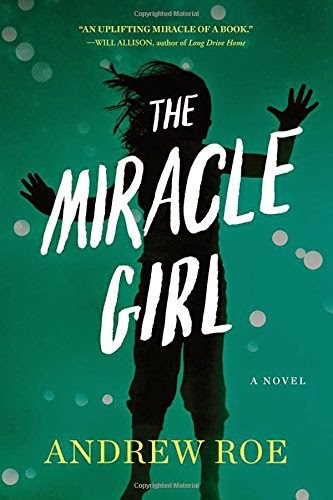
Book Review: "The Miracle Girl" by Andrew Roe

"Word spread. Somehow they heard about the little girl on Shaker Street, the one who almost died—who should have died—but didn't, and now she can't speak or move, she's paralyzed, mute, hooked up to machines and tubes, her body a living statue, but also holy, blessed, a gift from God, a child who heals and gives hope to those in need."

Eight-year-old Anabelle Vincent is in a coma-like state called akinetic mutism. She is unable to move or speak, and no one is sure whether she has any idea what is going on around her. Following the accident that left her in this condition, her parents made the decision to care for her at home rather than institutionalize her.

One day, a friend of her mother experienced what seemed to be a miracle after spending time in Anabelle's presence. She also noticed a religious statue weeping. Word quickly spread, and the visitors started coming from near and far, desperate to spend a few minutes with Anabelle, hoping against hope that she might help them or a family member combat disease, distress, infertility, poverty, or other problem. Within a few months, Anabelle has become an utter phenomenon, and people wait for hours on end outside her house for a chance to experience the same type of miracles that so many others have.

Anabelle's mother, Karen, has made it her life's mission to care for her daughter, even at the expense of her marriage, as well as her physical and mental well-being. She often can't remember the last time she left the house. Yet as she sees what hope Anabelle is bringing to others, she realizes she cannot deprive people the opportunity for the miracle that evaded the girl herself. So she opens her home to the visitors, the media, even the army of volunteers who help with everything from website updates to schedules.

Anabelle's father, John, left because he couldn't handle the pressure that caring for his daughter was putting on him and his wife. But as he drifts from place to place, job to job, never putting down roots for long, he can't help but wonder if his place is back with his family, despite the strain it may cause. And he wonders if Anabelle might give him the miracle of a family one more time.

Andrew Roe's The Miracle Girl is an insightful look at American life just before the millennium, the desperation of people to believe in miracles and have hope, and how a family copes with the idea that their daughter, whose own life is far from the one they dreamed for her, can provide such benefit to total strangers. It's also a look at the lives of some of those who come to Anabelle for help, as well as a teacher bent on proving that the miracles are hoaxes, and the priest who is part of his archdiocese's investigation into the purported miracles.

I found this book intriguing but uneven. Sometimes it was really compelling, fascinating even, but when the book shifted to the mundane details of Karen and John's lives, I lost interest. The book doesn't really take a position on what is happening, but a plot twist leaves a lot of things unresolved, and actually causes a few more questions than answers. But Roe is very talented, and definitely has created a thought-provoking story that may challenge your own ideas of whether miracles like these truly exist in our world.