Showing posts with label faith. Show all posts

Monday, August 30, 2021

Book Review: "Never Saw You Coming" by Erin Hahn

What do you do when your faith is tested? Erin Hahn explores how two teenagers deal with this in her upcoming book, Never Saw You Coming.

Meg has always done what was expected of her. She sings in her church’s praise band, gets homeschooled, dresses modestly, and never really interacts with guys beyond a strictly platonic level. But when she finds out that her whole childhood has been a lie, her world is shaken.

Micah’s father was a preacher who is now in jail, found guilty of embezzlement as well as numerous infidelities. His father was his best friend, and his betrayal shattered their family. Six years later, his father is scheduled for parole and Micah isn’t sure if he wants anything to do with him, much less be drawn back into the scandal surrounding his crimes.

When Meg takes her planned gap year before college and travels to Michigan’s Upper Peninsula to meet family she never knew she had, she starts to challenge some of the strict rules she lived under. And when she meets Micah, they bond quickly over their shared struggles with their faith and family, and when friendship starts to turn into attraction and love, things get even more complicated.

This book was beautiful and so thought-provoking, an exploration of faith and how it means different things to different people, and it was also a look at the hypocrisy that exists in religion, particularly in its treatment of women and girls and LGBTQIA+ people. But at its heart, this is a story about friendship, family, love, and finding your own path.

It’s funny, as a gay Jewish guy of a certain age I’m probably the furthest from Hahn’s “audience,” but I’ve loved every single one of her books. They just grab me from the start and touch my emotions in so many ways.

NetGalley and Wednesday Books provided me with a complimentary advance copy of the book in exchange for an unbiased review. Thanks for making it available!!

Never Saw You Coming publishes 9/7.

Saturday, December 19, 2020

Book Review: "You're Completely Normal" by Shannon Leyko

If you're looking to learn (or perhaps remember) how to trade where you think you should be for where you want to go, You're Completely Normal is for you.

We’ve all done it. At some point in our lives most of us have thought to ourselves, “I thought I’d be [fill-in-the-blank] by now.” I usually do it around milestone birthdays—30 was the toughest for me—but I definitely find myself uttering those words every now and again. (And if you've never done that, I tip my cap to you.)

As we all inherently know, there’s no prescribed path for anyone, no “right way” to be a spouse, a partner, a parent, an employee, a child, a person of faith, a friend. Yet all too often we get caught up comparing our journey and our lives to others, and social media adds to that pressure. (How many of us have thought, “I should have as many followers/friends as that person, I’ve been here longer!”)

Shannon Leyko knows these feelings all too well, and she encapsulates how she navigated (and still does) those feelings of fear and inadequacy, of measuring up to others, in this funny, insightful, and moving new book.

At first glance you might think this former Miss New York and mom of two is the last person who knows what it’s like to feel off-track, but you couldn’t be more wrong. In this book, she looks at nine overarching areas, including career, relationships, health and fitness, parenthood, friendship, and faith—where many tend to worry about how they measure up.

Maybe you’ve heard all of this before. But this book serves as a great reminder, a course correction of sorts, a reinforcement that no matter where you are and what path you’re on, you can find your own way without worrying about what others are doing. You're Completely Normal would make a great gift for the New Year!

Thanks to Shannon Leyko for a complimentary copy of the book in exchange for an unbiased review!

Friday, November 13, 2020

Book Review: "Reviving the Hawthorn Sisters" by Emily Carpenter

Reviving the Hawthorn Sisters, Emily Carpenter's new novel, is a suspenseful and compelling story of family secrets, faith, and love.

Eve’s grandmother, Dove Jarrod, was once a famous faith healer and evangelist. Eight years after her death, her granddaughter Eve runs her charitable foundation and fiercely protects her legacy. But regardless of her job, Eve knows the truth about her grandmother.

In the midst of great progress for the foundation and a film crew producing a documentary about Dove, Eve is confronted by a dangerous stranger bent on avenging Dove’s actions years ago. These actions, if true and if exposed, could topple Dove’s legacy permanently.

While Dove hid a lot of things in her life, is she guilty of murder? What motivated her to follow the path she did, and should her followers know the truth?

The story alternates between the present and the past, starting in 1934, when a young woman escapes from the psychiatric hospital where she was born and tries to forge a new life for herself, only to be dogged by a dangerous man.

This book had me hooked from the very start. I don’t know much about faith healing so I found it fascinating, but the whole story was tremendously compelling. It’s part mystery, part a story about finding the strength to overcome obstacles.

Reviving the Hawthorn Sisters is apparently a sequel of sorts to Emily Carpenter’s earlier book, Burying the Honeysuckle Girls, although you don’t have to have read that book to enjoy this one. I’ll definitely read that one too!⁣

Sabrina Dax and Lake Union Publishing provided me with a complimentary copy of the book in exchange for an unbiased review. Thanks for making it available!!

Friday, September 18, 2020

Book Review: "Transcendent Kingdom" by Yaa Gyasi

Yaa Gyasi's newest novel, Transcendent Kingdom, is a beautiful, moving look at grief, faith, family, and science.

Gifty is studying for her PhD in neuroscience at Stanford. Her research deals with depression and addiction, two things she knows all too well. Her older brother Nana, a talented basketball player, died of an overdose after getting addicted to OxyContin following an injury, and her mother has been virtually bedridden with grief and depression since his death a number of years ago.

While Gifty hopes to find scientific explanations for the issues that affected her family and so many others, she doesn’t truly understand the toll they’ve taken on her emotionally until her mother comes to stay with her. And as Gifty tries to find ways of reaching her mother, and struggles with completing her own work, she remembers the days of attending her mother’s evangelical church and the comforts and challenges it brought her.

This was such a gorgeously written book, a story of racism and the immigrant experience, the pain of addiction, depression, and loss, and the clarifying power for some of both science and faith. I felt like the emotions of this book almost snuck up on me the way they did Gifty.

I’ll be thinking about this one for a long time.

Friday, November 15, 2019

Book Review: "The Dearly Beloved" by Cara Wall

This one sneaks up on you with its gorgeous, contemplative story which grabs hold of your mind and your heart. Wow, how I loved this!

"Love is the enjoyment of something. The feeling of wanting something deeply, of wanting nothing more. Our love of God is not as important as our faith in God. Love wanes. Faith cannot. One can have faith and anger, faith and hate. One can believe deeply and still rail against God, still blame God. In fact, if one can hate God it is a sign of deep faith because you cannot hate and at the same time doubt God's existence."

James and Charles meet in 1963 when they are both interviewing to become the minister of an historic church in Greenwich Village. They couldn’t be more opposite from one another—Charles views his call as one to guide his congregation, to support them and help them understand events of the world, while James views his as a call to action, that God is served by changing the world.

The two are hired as co-ministers, which seems to suit them fine, and they become immensely close. The same cannot be said of their wives. James’ wife, Nan, a minister’s daughter, understands the role of the church in their lives, while Lily, Charles’ wife, has a definitive lack of faith shaped by a childhood tragedy that causes her to withdraw, even resent at times, the life her husband has been called to. Nan immerses herself in the church, Lily wants as far away from it as possible.

The Dearly Beloved follows the four through decades of friendship, love, loyalty, resentment, jealousy, and of course, faith. The challenges of the world, the tragedies and triumphs of their own lives will test and reaffirm their faith through the years.

This book was simply amazing. I cannot believe that this is Wall’s debut novel. It’s not a book that requires any knowledge of religion or faith—it’s more an exploration of how faith means different things to different people, and how it appears and disappears at different times in our lives.

James and Charles are the easier characters to embrace. I found Nan and Lily difficult to like for a while, until I understood their place in the story and realized the complexities Wall bestowed upon her characters.

I honestly think this is one of the best books I’ve read this year. It’s one of those that feels like the "great American novel," just a triumph of storytelling. That's something I don’t find too often these days.

Thursday, March 28, 2019

Book Review: "Little Faith" by Nickolas Butler

"How do you disagree with someone you love so fiercely?"

By and large, life has been good to Lyle Hovde. While he and his wife, Peg, dealt with the crushing grief of losing their infant son, they had the good fortune of eventually adopting a baby girl, Shiloh.

The teenage years were difficult, and there was a period during which she was estranged from them, but now she has returned home to their rural Wisconsin town with her six-year-old son, Isaac, in tow.

Lyle and Peg are doting grandparents, and Isaac brings them so much joy and love, along with a spark of life and energy as they head into their golden years. But while they love spending time with Isaac, Lyle, in particular, has been growing concerned with Shiloh's deepening alliance with a new church, one run by a magnetic young preacher whose ideas tend toward the extreme.

Faith has been a troubling concept for Lyle since the death of his son many years before. He and Peg still attend the church they always have—the church they met at, in fact—but Lyle doesn't quite believe in a divine being, or the power of prayer. He finds comfort in the familiarity of being in the same place every Sunday, of watching those around him grow old like he is, but he doesn't have any use for the words being spoken or the prayers being uttered.

When Shiloh and Steven, the preacher of her church, believe that Isaac has the ability to heal people, Lyle knows that his daughter is being led astray. He sees Steven for whom he truly is, but he knows that rocking the boat at all with Shiloh may cause her to leave and take Isaac away from them. As Steven's hold on Shiloh intensifies, Lyle and Peg begin to fear for their daughter and grandson, and that Steven may use them for his purposes.

The shaky detente continues until Lyle and Peg realize that Isaac's life may be in danger because of his mother's beliefs, and the influence of Steven and those in the church. As much as they want to keep the peace with their daughter, they know they must do everything they can to fight for Isaac's safety, even if it means jeopardizing their relationship with Shiloh. They cannot bear the thought of losing another little boy.

Little Faith is the latest novel from one of my absolute favorite authors, Nickolas Butler. (His first two books, Shotgun Lovesongs and Beneath the Bonfire, are two of the best books I've read in years.) This is more than a story of parents forced to choose between their daughter and their grandson. It's a tremendously thought-provoking meditation on faith, the beauty of old friendships, and the enduring power of love.

I loved this book so much. This reminded me in some ways like a novel written by Kent Haruf or Leif Enger, in that I just found myself in awe of Butler's prose, his imagery, and his exceptional characters. The story feels familiar but I was totally invested because I found so many of the characters so appealing, like people I wish I knew. You know where the story is headed and you hope you're wrong, but you cannot tear yourself away.

There's an immense charm to books that take place in small, rural towns, especially when the author has respect for their characters. Little Faith is really a triumph of storytelling and quiet emotion, one that I'll be thinking about for a long time afterward.

Thursday, June 28, 2018

Book Review: "The Book of Essie" by Meghan MacLean Weir

Praise the lord!!

How quick we are to judge people, even if (or especially) when we don't know them. This is even more the case where celebrities are concerned—we think we know the people we see on television or read about in magazines, yet quite often they're far more complex, and their lives are more complicated than we could ever imagine.

Esther "Essie" Hicks has spent nearly every minute of her life in the public eye. Her family has been a reality show staple with Six for Hicks long before her birth. The world has been both fascinated and repelled by her mega-church preacher father, her iron-willed mother who pulls all of the strings, and her siblings, as they've grown into adulthood and lives of faith and service all their own.

"Our family rejected materialism and popular culture and yet we also produced it. The show...paid for the SUVs Mother and Daddy drove, the lake house, the 'spiritual retreat' that was actually a villa in Saint John. It paid for the car seat I rode home in from the hospital, the muslin blankets I was swaddled in when I slept. It paid for my first backpack when it came time for me to go to school, Mother having by then completely abandoned giving lessons in the living room, not just because her time and energy were better spent promoting our brand but also because marketing said that what our audience wanted at that point was a character who was 'normal.'"

When Essie's mother Celia discovers she is pregnant, she and the show's producers must decide what to do. Do they spirit Essie out of the country for an abortion? Do they hide Essie away and then pretend that Celia has given birth to a miracle baby so late in life? Or better yet, do they marry her off, thus reaping the incredible publicity which could accompany a whirlwind romance and storybook wedding?

Celia doesn't realize that Essie is manipulating the situation, pairing herself off with a fellow classmate, Roarke Richards, despite the two of them never having spoken to one another. Roarke has his own secrets, but he is willing to help Essie sell their love story to the world. But once he finds himself part of the story, he realizes that there is far more to Essie than he ever believed, and she is not the judgmental, flighty sycophant he imagined she was.

With the help of reporter Liberty Bell, once immersed in her own media spotlight in the world of ultra-conservative religion, Essie hopes to make her true story known once and for all. But in the meantime, she wants to know why her older sister left home a few years ago, never to return, and wonders whether she'll be willing to help her. However, Essie and Roarke have to be willing to pay a tremendously high price if they share the truth with the world. Are they?

A meditation on the cult of celebrity and the hypocrisies they bring along, The Book of Essie was pretty fantastic. I was hooked from start to finish, even though I had a feeling how much of the plot might unfold. We've seen people like these characters in the media, or perhaps we even know people in similar situations without the glare of the public eye, and yet the story was utterly fascinating.

Certainly a story like this favors one "side" over another, but I liked the way that Meghan MacLean Weir didn't quite make Essie's family and others to be one-dimensional religious zealots. She certainly captured the fervor that conservative celebrities engender, and the issues they use to generate passion among their believers, but she didn't mock everyone with strong religious beliefs. She's a really talented storyteller, and she made you root for Essie and Roarke (and Liberty, too, to some extent).

In a world where everyone is just one or two viral videos away from temporary fame, The Book of Essie is a compelling, well-told look at how fame can be both a positive tool and a dangerous weapon, because of the way it can convince you that your version of reality is the right one. If you've ever wondered how a religious family might handle a scandal or two, this one's for you.

Saturday, March 4, 2017

Book Review: "Bed-Stuy is Burning" by Brian Platzer

No matter how far we believe we've come as a society, the issue of racial tension is still a very real one, one that can trigger violence as a result of real or perceived antagonistic actions. Couple that tension with the resentment often felt when a neighborhood predominantly occupied by minorities is on the cusp of being "gentrified," where long-time residents are pushed out by those with more money and greater ambitions, and you have a recipe for potential disaster.

Such is the environment in which Brian Platzer's novel Bed-Stuy is Burning is set. Bed-Stuy, short for Bedford-Stuyvesant, is a neighborhood in Brooklyn, New York. It's often referred to as "still gritty," even as wealthy people move in, drive up housing prices, and push others out. Aaron and his girlfriend Amelia are one such couple—Aaron, a former rabbi who left the rabbinate in a crisis of faith (among other things), is now a wealthy Wall Street banker, and Amelia is a journalist trying to find her big break. They live with their newborn son in one of the neighborhood's historic brownstones, once occupied by an African-American family.

Already-simmering tensions in the neighborhood are about to come to a head when a 12-year-old African-American boy is shot by police 10 times, and it is discovered he was holding a video game controller, not a weapon. A large group of youths are mobilizing, tired of the violence being perpetrated against them and tired of the haves getting what is rightfully theirs, and they're ready to take their neighborhood back. And in a split second, it explodes at full throttle, as rioting begins, with enormous numbers of young adults taking control and inciting violence, destruction, and total chaos.

It's not long before the riots reach Aaron and Amelia's doorstep. That afternoon, Amelia is home, ostensibly working, and the baby is being cared for by Antoinette, their nanny, a woman seeking religious salvation. Visiting Antoinette at the house is Amelia and Aaron's neighbor, Jupiter, a single father who is smitten with Antoinette, and wants her to know he will protect her, even as he worries about the fate of his own son during the riots. Also at home is Daniel, one of the tenants who lives in Aaron and Amelia's basement apartment. Daniel is an increasingly suspicious person who has grown slightly afraid to leave his home.

While Amelia, Antoinette, Jupiter, and Daniel deal with circumstances at home, Aaron is struggling with dangerous circumstances of his own. And over the course of one afternoon, each of these individuals will be affected by the events of the day, events which will test them physically and emotionally, challenge everything they hold dear, and make them wonder about what the future holds.

I thought Bed-Stuy is Burning had a lot of potential, a lot of things going for it. Platzer is a capable storyteller, and I really found Aaron in particular a fascinating if flawed character. I felt as if in trying to tell a comprehensive story, Platzer took on more than was necessary. If the plot really was about the events of that day, I found the periodic forays into the backgrounds of all of the supporting characters, including a young rioter and even NYC Police Commissioner Bratton(!), extraneous. I also really wasn't sure what Platzer's ultimate message was here, because the characters' actions didn't all add up for me. (In particular, I was unclear about one of Antoinette's interactions with the baby.)

Sometimes books have great ambition but don't succeed in the execution. For me, Bed-Stuy is Burning was one of those books. Platzer's talent is impressive, and he definitely knows how to ratchet up suspense and tension. Some may not be as thrown off course by what I found excessive about the plot, so if what I've described appeals to you, definitely give it a try.

NetGalley and Atria Books provided me an advance copy of the book in exchange for an unbiased review. Thanks for making this available!

Monday, October 3, 2016

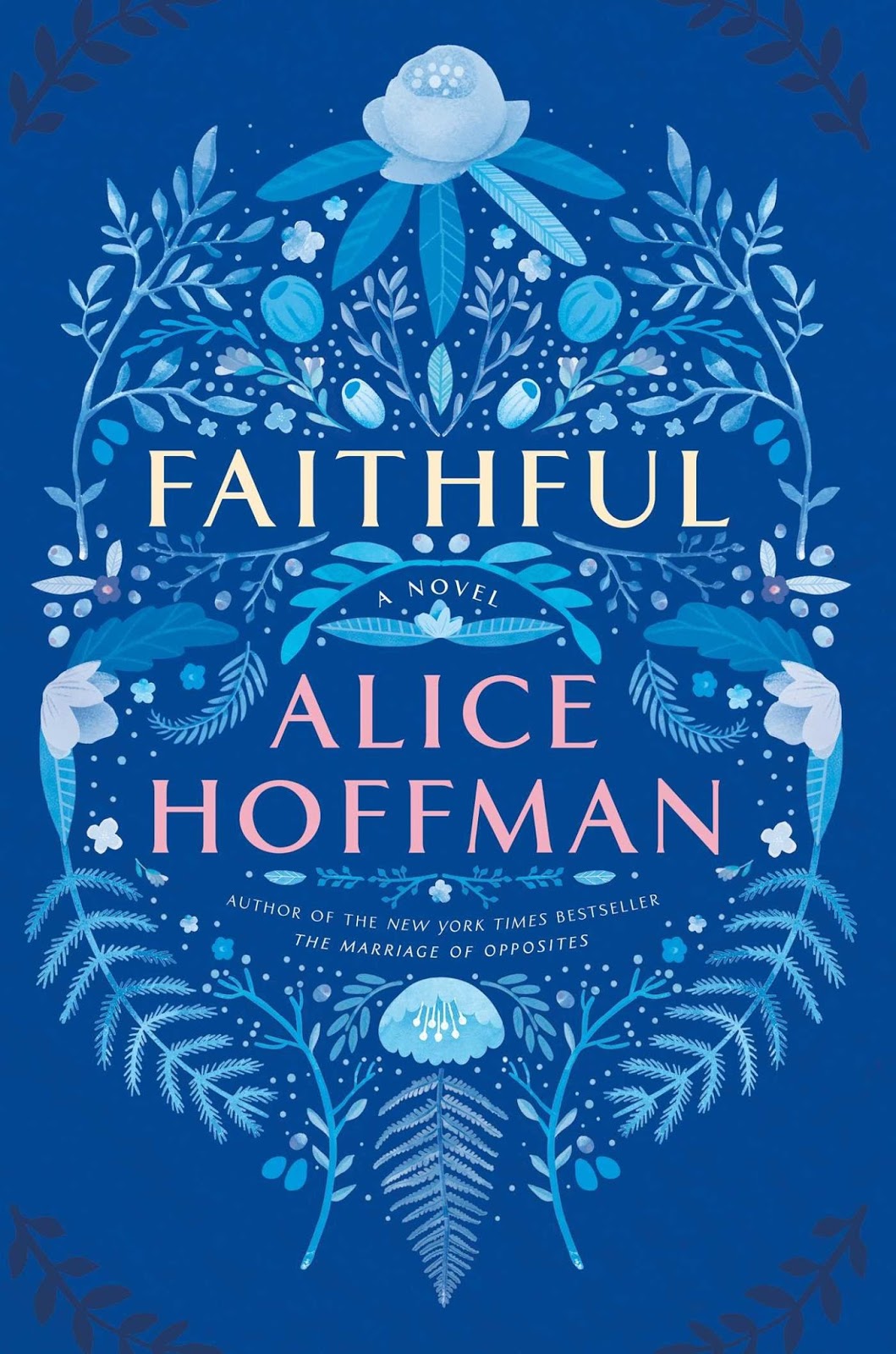
Book Review: "Faithful" by Alice Hoffman

"Shelby knows what's wrong with her. She is paying her penance. She is stopping her life, matching her breathing so that it has become a counterpart of the slow intake of air of a girl in a coma."

Shelby and Helene were inseparable best friends from the moment they met in childhood. Helene was always known to be the prettier one, and Shelby was fine with that—she was just happy to be part of Helene's orbit. But as often happens with childhood friendships, as high school drew to a close, Shelby became more and more frustrated with Helene's superior attitude, her habit of treating people (including Shelby) with disdain, simply telling them what they want to hear in order to get what she wants.

One night, while driving to a party Shelby doesn't want to go to, but afraid to lose Helene's friendship, there is an accident. Shelby is able to essentially walk away from the accident mostly unharmed (at least physically); Helene is left in an irreversible coma. From that moment on, Shelby knows her life is destined to go nowhere—she must pay the price for destroying her best friend's life. She lives in the basement of her parents' suburban Long Island home, college, and life, for that matter are no longer an option. She burns with anger and guilt, not allowing anyone to get close to her, except the former high school classmate who sells her drugs to numb her pain.

But as Shelby lives every day as if it is her punishment, she has occasional glimmers of hope. She receives anonymous postcards from a shadowy man who she thinks of as her guardian angel, a man who has been watching over her since the night of the accident. But she doesn't know whether this person is real or if someone is playing a joke on her, hoping she'll let her guard down enough to wound her. She moves to New York City and slowly, unexpectedly, starts to eke out traces of a life for herself, although she never allows herself to feel truly happy with anyone or comfortable anywhere, because how would that be fair?

Faithful is an exquisitely beautiful book about feeling unworthy of happiness or success because you believe you must pay the price for a costly misstep. It's a book about being surprised when the people who matter don't walk away no matter how hard you push them to, and realizing that one accident doesn't mean you are damaged goods forever. But more than that it's a book about learning to give yourself to other people again, learning to let yourself experience the joys of friendship, love, and having people depend on you—and realize that you can't punish yourself forever.

This book started off a little slow, and I wasn't sure if I would enjoy it, because at the beginning, Shelby is a miserable character. (Rightfully so, but still...) The tone and the subject matter reminded me a little bit of Susan Perabo's The Fall of Lisa Bellow (which I just read), in that one girl wonders why she was able to evade the disaster which befell another. But little by little, as Shelby's tough, angry, hurting exterior started to give way, I fell in love with this incredible story and these characters.

Not everything in this book works perfectly, but the emotion and the heart of the plot are just amazing. There were times I worried that Alice Hoffman was going to veer the plot into truly bleak territory and I think I might have given up on the book if she did, but she just kept letting the reader discover the kind of person Shelby was, at just about the same time Shelby was rediscovering that. Shelby is a fascinating, well-drawn character I just loved reading about.

I've read so many of Hoffman's books over the years, and I've always been a huge fan. (Here on Earth, while perhaps a little melodramatic, is one of my all-time favorites.) But because the subjects of her last few books didn't appeal to me, I had nearly forgotten how much I love the way she writes. I'm so happy to have "found" her again, because despite its faults, I really loved Faithful. I just don't think you can go wrong with a book that gives you a little bit of hope, you know?

NetGalley and Simon & Schuster provided me an advance copy of the book in exchange for an unbiased review. Thanks for making this available!

Monday, September 26, 2016

Book Review: "Eveningland: Stories" by Michael Knight

I don't know about you, but I have a list (both mental and written) of authors whose work I have enjoyed through the years, and from time to time I check all of the book-related websites to see if any of these people have books coming out in the near future. Some of these authors are more prolific so I don't have to wait a long time between books, but others keep me waiting for years, and in certain cases I wonder whether they're even planning to write another book.

I found Michael Knight's work when his first novel, Divining Rod, and his first story collection, Dogfight and Other Stories, were both released in 1998. The power of his storytelling emanated from his use of language and rich characterization, as well as his ability to create tension and drama without resorting to histrionics or elaborate plot devices. And although Knight's stories appeared periodically in publications following the release of his first two books, I waited five years for his next one, and then seven years for the one after that. (I wasn't aware he had written a holiday-related novella between the two.)

Since 2010 I've been hoping Knight had another story collection or novel in him, so when I saw on NetGalley that his latest collection, Eveningland, was due out in March 2017, you can bet I submitted my request as soon as possible! Six years of elapsed time haven't dulled his talent, and reading these stories felt like visiting with an old friend, a person with whom you can talk for hours on end.

Eveningland is a collection of seven somewhat-connected stories, each of which takes place in Knight's native Alabama. The stories are set between the Deepwater Horizon oil spill into the Gulf in 2010 to the arrival of a destructive hurricane, although not every story is firmly rooted in time as a concept. Each story focuses on relationships—between husband and wife, lovers, family, even strangers. And while each story seems relatively simple, it's surprising how quickly these characters find their way into your mind.

All of the stories in this collection worked for me on some level, but my favorites included: "Smash and Grab," in which a teenage girl turns the tables on a burglar—and keeps him guessing; "Grand Old Party," which tells of a man who suspects his wife's infidelity and decides to confront her and her lover, but doesn't think it through; "Jubilee," about a long-married couple preparing for the husband's 50th birthday party; "Our Lady of the Roses," in which a young art teacher at a Catholic school finds herself at odds with her career, her faith, and her relationship; and "Water and Oil," which tells of a teenage boy worried about the encroaching oil spill yet distracted by a more worldly waitress at his father's marina.

There are flashier short story authors out there, but Knight is a tremendously talented storyteller. Eveningland sneaks up on you quietly, hooks you quickly, and leaves you wanting more from Knight. I hope I don't have to wait six more years!!

NetGalley and Grove Atlantic provided me an advance copy of the book in exchange for an unbiased review. Thanks for making this available!

Wednesday, August 24, 2016

Book Review: "I Will Send Rain" by Rae Meadows

I love it when a book slowly takes you by surprise, as you realize what on the surface seemed like a fairly simple story dazzles you with emotion and beauty of its telling, when a story about a family tested by difficult times and tragedy reveals its richness, layer by layer. Rae Meadows' newest book, I Will Send Rain, is definitely one of those books.

The town of Mulehead, Oklahoma, as with many towns in the Great Plains region of the U.S. in the mid-1930s, cannot escape the drought. It's wrecking havoc on farming families everywhere, including Annie Bell and her husband, Samuel, who moved to Oklahoma as homesteaders and little by little, built a farm they were proud of, then a family. But now the Bells are suffering—their crops yield little, and the whole town is paralyzed by the economic and emotional effects the drought is having.

When the dust storms start hitting Mulehead, the Bells truly feel they're close to rock bottom. Samuel, who tries valiantly to keep his farm limping along, is suddenly plagued by dreams of severe rain that he cannot explain, nor can he explain what he is compelled to do as a result of those dreams. Their 15-year-old daughter, Birdie, is in the flush of young love and wants much more out of life than Mulehead can offer her, but doesn't think anyone can understand her hopes and dreams, even if she is risking her chance at freedom. The Bells' young son, Fred, a sensitive, old soul, is plagued by dust pneumonia, and Annie herself finds herself tempted by a new admirer for the first time in her life, and is unable to understand the fervor of her husband's actions.

"More and more, he saw the drought as a test of faith. More and more, she feared the drought would free this tight coil of restlessness in her, expose her as someone less than steadfast."

As conditions in Mulehead worsen, Annie is torn between the path she has taken her entire life and the chance for something new, something that might offer her a way out of the crushing devastation the community is experiencing. But can she risk everything she has, everything she knows, for the slim hope of a chance? Does she really want to? And as Annie tries to make sense of what is happening to her family, her home, and her faith, she knows that problems won't simply be solved with much-needed rain, but she has to decide whether to see things through or finally live life for herself.

I thought this book was truly lovely, full of tension, emotion, anguish, and hope. Meadows so perfectly captured the anxiety and fears of this terrible period in American history, how people were affected and how they coped. As I mentioned earlier, this seemingly simple story of a family dealing with adversity packed so much power, so much beauty, that even when you had a feeling how certain plot threads might resolve themselves, you felt the story and these characters in your heart.

I'll admit that at first I was hesitant to read I Will Send Rain because historical fiction doesn't always resonate with me. But this book was really just so good, and Meadows' storytelling ability shone through a book which takes place in such a drab time and setting. This is a book—and an author—worth taking into your heart.

Sunday, October 4, 2015

Book Review: "After the Parade" by Lori Ostlund

I recently devoured Lori Ostlund's short story collection, The Bigness of the World, which I absolutely loved. (See my original review.) I so fell in love with her writing and her storytelling ability that I very quickly jumped into reading her debut novel, After the Parade. While I don't think I loved this book as much as her stories, I continue to be dazzled by Ostlund's talent and her ability to provoke so many different emotions with her writing.

Aaron Englund has been with his older partner Walter for 20 years, since Walter rescued him from a lonely existence in his small town of Morton, Minnesota. But while the two shared a strong bond, Aaron felt that Walter always controlled him, and never let him forget that he saved him. So one day, Aaron leaves their home in New Mexico and heads to San Francisco, where he hopes to start a new life and continue his career as an ESL teacher.

"Perhaps that was the nature of love: either a person was not in it enough toc are, or was in it too deeply to make anything but mistakes."

Settling into a small garage apartment in San Francisco, Aaron begins to realize that a new life isn't all it's cracked up to be. While he enjoys helping his students maneuver their way through the idiosyncrasies of the English language, he spends most of his time alone, knowing he did the right thing in his relationship with Walter yet still missing him, and feeling ever more alone and isolated, but scared and unwilling to try and make new friends.

Through flashbacks we get a better understanding of what has shaped Aaron into the man he has become. His angry, abusive father was killed in a freak accident when he was five, and his mother vacillated between smothering and distant. He never felt he was the same as his fellow classmates, and he often was the object of ridicule and/or bullying. Throughout his childhood and young adulthood he encountered a number of people whose differences were either physical and emotional, yet he felt at home with them. And then, while he was in high school, his mother left home in the middle of the night with the town's priest, and she never connected with Aaron again.

After the Parade is a moving story about feeling isolated, feeling different, and how our relationships and personalities are shaped by the things that occur in our lives. I felt for Aaron so much as I learned more about him, his likes and dislikes, and his inability to feel comfortable letting his guard down. But at times the emotional distance at which his mother kept Aaron, and Aaron keeps the world, translated into an emotional distance for me as well, so at times I was frustrated by Aaron's inability to act, to say what was on his mind, to do something that might bring a change in his life, although I understood why.

This is a story that unfolds slowly (very slowly at times), and while the flashbacks are tremendously valuable for insight into his character, I would have enjoyed spending more time with Aaron in adulthood than in childhood. But while this isn't a book I necessarily enjoyed, it was a book that moved me, and Ostlund's talent is on full display here. It's definitely a book that has me thinking.

Tuesday, November 11, 2014

Book Review: "Rare Bird: A Memoir of Loss and Love" by Anna Whiston-Donaldson

I remember in September 2011 when the Washington, DC area was hit by a quickly moving and unexpected set of rainstorms that left highways flooded, creeks running far over their banks, and trees felled. While we were fortunate not to lose power, many in the area did. I remember reading that several people were killed during those storms, mainly as a result of getting caught in the floods, including a 12-year-old boy from the town next to ours, who apparently fell into one of the creeks affected by the massive amount of rainfall. I couldn't even fathom the loss his family and friends were feeling, and that boy, Jack Donaldson, remained in my mind for a few weeks as I read and watched a number of follow-up news stories about the aftermath of his death.

So several years later, when I read that his mother had written a book about coping with this loss, and struggling with her faith, I felt drawn to it. Having lost my father unexpectedly just about six months ago, I knew this book would affect me, but it did both in ways I anticipated and ways which surprised me.

Anna Whiston-Donaldson was a blogger who chronicled her family's life, their faith, and her decorating tips. She and her husband, Tim, had two children, Jack and Margaret, and they were deeply rooted in their community, their church, and in their circle of family and friends. The four of them were tremendously close-knit, and Anna was always a very protective parent, warning her children of potential dangers and trying to keep them safe at all times, an irony not lost on her after Jack's death.

Jack was an athlete, an actor, always striving to make his friends and family laugh. But he was also tremendously sensitive, complex, and very cautious—as Anna's sister said after Jack's death, "I don't get it. If there was a poster child for 'kid least likely to get swept away in a stupid creek,' Jack would be the one."

Rare Bird is as poignant and heart-wrenching as you'd imagine an account of a mother's grief after the sudden loss of a child could be. But Whiston-Donaldson is careful not to portray Jack as perfect; she paints a complete picture of a complicated, loving, intelligent, and special child, who undoubtedly would have grown into an exceptional man. And she is honest about her feelings—the blame she places on herself for letting her children go out and play in the rain that night, struggling with her belief in God after this loss, and the challenges she faced in dealing with her husband, her daughter, and others while processing her grief.

"But maybe all deaths feel like this—improbable, strange, untimely, unnatural. Maybe every single death needs to be examined, spoken of aloud, and turned over in the mind to make it seem more real. And perhaps not being able to grasp all at once what has happened is a small mercy in itself."

This is an important and powerful book for anyone dealing with grief. I identified with many of the things Whiston-Donaldson said, such as, "I soon learn that prior closeness does not determine who will show up for you." Even though I didn't lose a child, nor do I share her religious beliefs, I was moved and affected by what she had to say. Grief is, sadly, a universal emotion, but how we deal with it is so individual, yet many of her frustrations, fears, and regrets spoke to me.

For her sake and the sake of her family, I wish that Anna Whiston-Donaldson's first book, as she said she thought it would be, was about painting furniture. Yet I feel tremendously fortunate that she was willing to share her family, her grief, her faith, and most importantly, her son, with us.

Thursday, March 27, 2014

Book Review: "Of Sea and Cloud" by Jon Keller

Full disclosure: I received an advance readers copy of this book from NetGalleys in exchange for an unbiased review.

Nicolas Graves has known nothing more than the life of a lobsterman. Day in, day out, year after year, he has focused on hauling in lobsters, setting his traps, and worrying about the price per pound. This single-minded focus was for the benefit of his family, but while he and his son Bill were tremendously close, his relationship with his son Joshua (known as Jonah) was fraught with tension and misunderstanding from an early age.

When Nicolas is lost at sea, Bill and Jonah pick up their father's mantle as lobstermen. Both learned at their father's side, and while Jonah left to go to college, he returned to follow in his father's footsteps. Yet their father's death has left them at odds—the two sons don't share the same opinions on what to do next, and have different priorities, especially as the price of lobster plunges across the world.

Bill wants nothing more than to continue as his father would, while Jonah isn't sure that this way of life is the answer anymore. While Bill finds himself enmeshed in a romantic relationship with a girl he grew up with, Jonah is restless and wonders whether his father's death wasn't some kind of sign. Yet as the brothers struggle with each other, and Jonah must deal with his unresolved feelings about his relationship with his father.

But Bill and Jonah also find themselves at odds with an unexpected enemy—Osmond Raymond, their father's partner in the lobster pound business for years. Osmond is also the town preacher and a deeply vengeful and difficult man. Despite his years of loyalty and friendship with Nicolas, he is determined to take control of the business for the sake of his children and grandchildren—no matter what the cost to Bill and Jonah, and no matter what gets destroyed in the process.

Of Sea and Cloud is a powerful story of loyalty—to family, friends, and a way of life that gets harder and harder. It's a story of relationships, resentments, unspoken fears and hurts and arguments. It's also a story of fighting for what you believe in, no matter what the cost. It's a familiar story, but Jon Keller tells it quite adeptly.

Keller is an excellent writer, and this book has a very strong voice that makes you feel as if you're among the lobstermen, deeply enmeshed in their day-to-day struggles. While these characters may be similar to others you've seen in other books, Keller's storytelling ability still keeps them interesting and fresh, and makes you want to keep reading about them. The feeling of tension and of weariness are palpable in this book, and they really set the mood.

The life of lobstermen is one I can't really imagine, but Of Sea and Cloud gave me enough insight into their challenges that I was able to understand why they do what they do every day, and why they struggle in face of danger and economic challenges. This is an interesting, well-told book that resonates.

Friday, January 31, 2014

Book Review: "The Gospel of Winter" by Brendan Kiely

Wow. This is a powerful, emotionally moving, and fantastic book.

Sixteen-year-old Aidan Donovan has always existed on the fringes of things. A loner more content to snort Adderall and read by himself, as his wealthy parents' marriage disintegrates, he's more comfortable with Elena, their housekeeper, than his parents or friends his own age. He doesn't have any patience for the dishonesty or non-genuineness of the community where he lives.

"Nobody ever said I don't know or I'm afraid, and they acted like the masks they wore were their real faces and that they could sustain themselves forever on their own self-assurance—like they really believed they didn't need anybody else. What was that John Donne poem we read in Weinstein's class, 'No Man Is An Island'? Not here. We were a goddamn social archipelago that called itself a community. Why did I feel like I was the only one who lived in a nightmare? What was worse was that I knew people did have fears."

The only place Aidan truly feels comfortable is at his church, Most Precious Blood, as Father Greg, the local priest, is the only person who seems to care about or listen to him. As he starts making friends with a trio of his classmates—Josie, the charismatic girl on whom he's had a crush for some time; Sophie, the wild but friendly girl with a reputation; and Mark, the swim team captain with issues of his own which mirror Aidan's in more ways than he knows—Aidan starts to feel a little more comfortable in his own skin.

As Aidan balances the comfort of his new friends with his discomfort about his home life, he starts to realize that Father Greg's affections are not just directed at him alone, and while he mourns the feeling that he is no longer special, he also grapples with the reality of what the priest has done. What does that make him? Would telling people, admitting what has happened, make those in his community blame and think less of him, as the priests have led him to believe? Can he just pretend that nothing happened?

Aidan's community—and the nation—begin confronting the revelations about sexual abuse by priests, and people want to know if Aidan was affected, what he knew, but he'd rather ignore the whole thing, despite the toll it takes on his own psyche and those around him. Only as he realizes the true consequences, and what could lie ahead for him depending on the path he chooses, does he realize that there are other people who care about and love him.

"I thought about how people like Old Donovan and Father Greg and teachers and even Mother and Elena tried to give me advice about who I was supposed to be and what kind of person I was supposed to become, but looking at Josie, I wondered if it didn't all come down to something simpler: Are you the kind of person who is there for people when they need you, or not? Isn't it in those moments when you have to work harder than you thought you could to reach out to another person, and you do, that you finally find the you who's been hiding behind the mask all that time? Is it there, finally truly naked, and reaching for one another, that we create the chance to hold one another again? And what about the chance to love again? Do we get to create that possibility too?"

This was a phenomenal book. Its subject matter was difficult, but Brendan Kiely's use of language and his storytelling ability captivated me completely. I loved Aidan's character and felt so much pain and hope for him. I could definitely identify with some of his thoughts and fears and hopes, as I remember feeling similarly as a teenager. I devoured this book, reading nearly the entire thing in one day. It was just such a beautiful, powerful, painful yet hopeful story, and I hope this gets the attention—and the readership—it so truly deserves.

Thursday, January 30, 2014

Book Review: "Foreign Gods, Inc." by Okey Ndibe

Don't mess with the deities, for you know not what they'll do.

Ikechukwu "Ike" Uzondu is a Nigerian taxi driver in Brooklyn. He's having a tough time of it. Educated at Amherst College, intelligent and ambitious, he is determined to make a better life for himself, but he is unable to get a job because his accent is so thick. Instead of marrying for love, he married for the possibility of a green card, yet wound up with a shrewish wife, who constantly demanded money, accused him of having affairs, cheated on him, and divorced him, taking much of his savings.

But now the rent is due, his gambling debts have him strapped for money, and the emails from his sister and mother back in Nigeria begging for money are becoming increasingly more strident and demanding. Inspired by an article about Foreign Gods, Inc.—a tony New York gallery that specializes in the purchase and sale of deities from foreign countries, Ike decides his best hope for fortune and comfort is to return home to Nigeria and steal Ngene, his ancestral village's war idol. After all, as he has read, "In a postmodern world, even gods and sacred objects must travel or lose their vitality; any deity that remained stuck in its place and original purpose would soon become moribund."

Ike's return home to his village is not as smooth as he had hoped. He nearly gets arrested several times in the airport because he refuses to give customs officials and others the bribes they expect. His mother and sister have fallen under the influence of a corrupt, maniacal Christian preacher, who has captivated many in his village with promises of salvation and talk of the devil. And his mother is at war with Ike's uncle and grandmother, as she has been led to believe by the preacher that they were responsible for Ike's father's death because they worship Ngene, not Jesus.

Foreign Gods, Inc. is in part a meditation on what it's like to be an immigrant in the U.S., and part a reflection on what it's like to return home to a country and a culture you tried so hard to leave behind. At times the book is satirical, as it pokes fun at the mangled English the characters use ("Now I have to be a fantastic hostage by tabulating a drink in front of you," one of Ike's friends says) and their fascination and disbelief at American ways. Toward the end of the book, it turns metaphorical, as Ike begins to experience—or is he simply imagining—the consequences of stealing Ngene away from the village.

Okey Ndibe tells an amusing and intriguing story which may have more roots in truth than I'd imagine. It ran a little slow in places, but Ike's character is fascinating, and his plight made for a compelling read.

Saturday, November 30, 2013

Book Review: "This is the Story of a Happy Marriage" by Ann Patchett

Many people ask me how I select the books I read. Sometimes they've been recommended by someone else whose preferences are similar to mine, or I've read enthusiastic reviews about them. In other cases, I've been intrigued by the title or even the cover. (Never underestimate the power of a stroll through a bookstore when you can find one.) But quite often, I choose books written by authors whose books I've come to love. There is a growing list of authors I'm constantly looking up on Amazon to see when their next book will be released, authors whose books I read sight unseen, unless they're a major departure from their usual work.

Ann Patchett is definitely one of those authors. I first became familiar with her after reading the marvelous Bel Canto, then read her earlier books and have devoured all of the books she has written since then, fiction and nonfiction. So I was intrigued to read This is the Story of a Happy Marriage, a collection of articles and other writings she has published in a wide variety of media, from The Atlantic Monthly and The New York Times to Gourmet and Granta, even her introduction to the volume she edited for The Best American Short Stories collection.

Contrary to the title, this isn't just a book about marriage, although several of the articles touch on different aspects of her relationship with her husband Karl through the years. But many of the articles touch on other relationships—her brief, disastrous first marriage; her friendship with the late poet Lucy Grealy (which Patchett so lovingly recounted in her book Truth & Beauty; her grandmother; her dog; one of the nuns that taught her in Catholic school; even her relationship with her work. And still other articles talk about her need for and love of the occasional solitary vacation; her experiences trying out for the LAPD and getting to understand the RV culture; becoming the co-owner of an independent bookstore in Nashville; and her love of short stories.

"Many of the essays I'm proudest of were made from the things that were at hand—writing and love, work and loss. I may have roamed in my fiction, but this work tends to reflect a life lived close to home."

As always, Patchett's writing is thought-provoking, humorous, and, at times, tremendously moving. The articles aren't arranged in chronological order in the book, and they're written for different purposes, so it may take a minute to get your bearings for you to realize where in Patchett's life a particular essay is taking place. (In some she's married, in others she's dating her future husband; in some her dog is a puppy and in some her dog is elderly.) But Patchett always provides context for what she's talking about so it's interesting to get so many different perspectives.

There were so many instances in which I marveled at what Patchett had to say. Her use of language is so dazzling at times I had to re-read paragraphs or sentences to get the full extent of their power. In the title essay, for example, when she recounts the tumultuous relationship she and her husband had in the years before they were married: "I try to study our happiness so that I will be able to remember it in the future, just in case something happens and we find ourselves in need. These moments are the foundation upon which we build the house that will shelter us into our final years, so that when love calls out, 'How far would you go for me?' you can look it in the eye and say truthfully, 'Farther than you would ever have thought was possible.'"

And one other example, from "Dog Without End," a beautiful tribute to her dog: "Sometimes love does not have the most honorable beginnings, and the endings, the endings will break you in half. It's everything in between we live for."

I loved this book as much as I've loved Patchett's fiction. I feel tremendously fortunate to have gotten so much insight into her life, her mind, and her heart, and I think this will help enhance my enjoyment of her future work even more. If you like her writing, definitely pick this up. It's tremendously captivating, even if you choose to read it a little at a time rather than all at once. Don't miss out.

Friday, September 6, 2013

Book Review: "The Explanation for Everything" by Lauren Grodstein

I've often remarked that at times I just want to enjoy a book or movie simply for what it is without thinking about heavier issues, or dissecting how plausible the plot may actually be. Sometimes I just want to laugh, or cry, or be transported into some fantastical place or time, without considering deeper meaning. The converse, however, is also true—sometimes I enjoy books or movies that make me think, that stretch my mind beyond simply appreciating the talent that went into the work's creation, and perhaps force me to consider different perspectives or ideas.

Lauren Grodstein's new novel, The Explanation for Everything, definitely falls into the latter category. Andy Waite is a biologist at a small New Jersey college. He is a diehard evolutionist, having learned from one of the foremost experts on the topic while he was a graduate student at Princeton. But Andy's life hasn't gone the way he planned—he's raising his two young daughters on his own following the sudden death of his wife several years ago, he's worried about getting tenure, and he's trying to make the results of his years of research make enough sense to be worthy of a major scientific grant.

Andy teaches a biology course called "There is No God." While rarely students try to challenge what he teaches, every so often he has a student express dissent about the Darwinian and other scientific theories he introduces them to. One day he is approached by Melissa Potter, a transfer student, who asks Andy to direct her independent study. But it isn't any theory Melissa is interested in pursuing—her independent study will focus on intelligent design, the idea that the creation of the universe and science must have been the work of an intelligent designer, or God. Melissa's course of study is in direct contrast to everything Andy has taught and believed for years.

As Andy struggles with the everyday challenges of raising two daughters on his own, trying to further his career, and dealing with the memories of his wife, he begins to wonder if everything that he has put his belief in might not be as black and white as he has thought. Is there a God? Should we put our faith in a creator, instead of in science? This book explores both sides of the debate, and wonders if a little faith is truly what we need to survive.

I was tremendously intrigued by this book and think Lauren Grodstein is a tremendously talented storyteller. I liked the fact that she explored the ideas of evolutionism and intelligent design without ultimately saying whether one is right and one is wrong, instead allowing you to make your own conclusions. While Andy at times was a little bit passive (understandably), I thought the struggles his character went through were moving and truly human. And when the book dealt with his own questions of faith and trust, the story really resonated with me.

Although there were a few subplots in the book, one involving Andy's neighbor and one involving an outspoken student, that I didn't feel were fleshed out as much as the rest of the story, I found this book very compelling without being heavy handed. Having read and thoroughly enjoyed Grodstein's previous novel, A Friend of the Family, one which also raised questions for me while drawing me into the plot, I am a definite fan of her storytelling ability, and I look forward to continuing to watch her career progress.